
What makes the human brain different from other primates?

Emily Meyer was the lead author on this study. Emily is currently a graduate student in Mike Arcaro's lab. She is interested in combining behavioral, computational, and physiological techniques to understand the visual system. Her main work involves studying tree shrew's ability to recognize objects as a window into the evolutionary origins of primate vision.
or technically,
Expansion of a conserved architecture drives the evolution of the primate visual cortex
[See Original Abstract on Pubmed]
Authors of the study: : Emily E. Meyer, Marcelina Martynek, Sabine Kastner, Margaret S. Livingstone, Michael J. Arcarco
While humans aren’t the only impressive animals, there’s no denying that we have evolved some unique and remarkable abilities. Identifying what about our brains makes us human has been a longstanding debate in neuroscience that often centers around comparisons of human brains to those of other animals. While there are lots of interesting comparisons to be made between the brains of humans and animals like flies and birds, one of the most effective approaches to understanding what makes us human is to compare our brains and abilities to some of our closest evolutionary relatives: non-human primates. This is because non-human primates have the most in common with us, so it’s easier to find and make sense of differences in our brains and how they relate to differences in our abilities. One notable difference between humans and many other primates is that our brains are bigger, so figuring out what brain changes accompanied this growth in size might give hints into what aspects of our brains give us our unique human abilities.
One way to track how brains differ between species is to look at how the brain’s many subdivisions, called brain regions, have changed. This is because brain regions typically contribute to different functions. For example, different brain regions process inputs from the eyes and ears, and still other brain regions help with more complex cognitive functions like storing memories. Neuroscientists have proposed at least two ideas for how brain regions changed as evolution moved from smaller primate brains to human brains. The first possibility is that bigger human brains are filled with many more brain regions that support new functions (Figure 1, left). The idea here is that bigger brains make room for more brain regions, and that new brain regions are needed to support any new functions. The second possibility is that human brains are composed of mostly the same brain regions as smaller and evolutionarily-older primates, but that those brain regions got bigger (Figure 1, right). Under this second hypothesis, differences in which brain regions have grown most relative to each other would support the emergence of new abilities in humans relative to other primates.
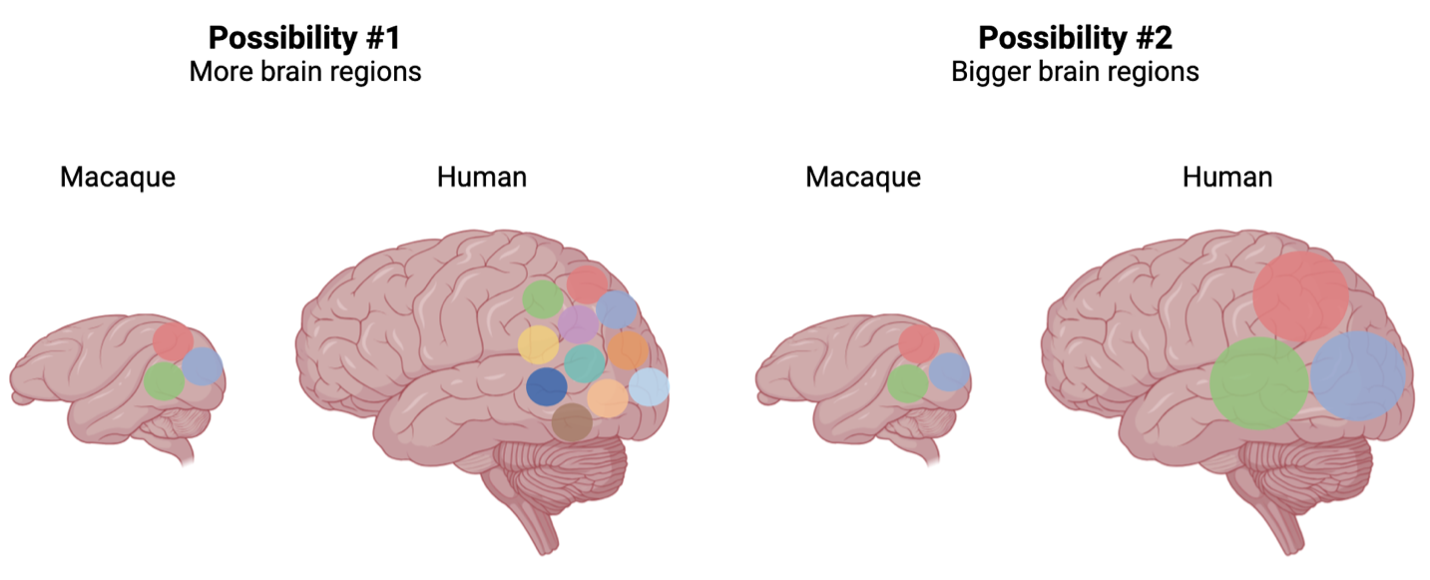
Figure 1. Two possibilities for how brain regions changed between macaques and humans as brain size got bigger. In these cartoon illustrations, each colored circle represents one brain region. Left: The first possibility is that larger human brains have more brain regions. Right: The second possibility is that larger human brains have the same number of brain regions, but they’ve gotten bigger. Figure generated with BioRender.com.
Emily Meyer, a student in the Neuroscience Graduate group, compared the brains of humans and monkeys (specifically rhesus macaques) to distinguish between these two possibilities. In order to make comparisons, the team first had to decide how to define what constitutes a brain region. Meyer and her team chose a method that focuses on the parts of the brain that respond to light hitting the eyes, often referred to as visual inputs. Specifically, when light hits the back of the eye, called the retina, different parts of the retina connect to different parts of the brain. By measuring brain activity while moving light across the eyes, neuroscientists can produce maps of which parts of the brain are responding to light on which parts of the retina. Each brain region has a complete map of the retina, so each complete map is considered its own brain region. These maps are referred to as retinotopy (“retino”- of the retina, “topy”-position). Importantly, retinotopy can be easily measured in both humans and macaques. “Historically, people have used a lot of different methods to define different areas of the brain that are not easily comparable,” says Meyer. “Being able to use the same method in both species is one major advantage [of using retinotopy].”
By comparing retinotopy in human and macaque brains, Meyer and her team found evidence for the second possibility for how brain regions differ between macaques and humans (Figure 1, right). While human brains are bigger and have four times as much brain tissue dedicated to processing visual inputs, the team identified approximately the same number of visually-responsive brain regions in both species. What makes this particularly exciting is that many of the identified brain regions have known functions. “There is a correspondence [between humans and macaques] in what each of these brain regions do,” says Meyer. “Being able to look at that across evolution can give insight into what has expanded in size and how it relates to expanded or new function.” To make these comparisons, they needed to identify which brain regions had changed the most.
Interestingly, while the team found that visual brain regions had remained equal in number, some brain regions grew more than others. Visual areas build on each other from what neuroscientists refer to as lower-level to higher-level brain regions. Lower-level brain regions have simpler functions (like identifying the edges of objects) while higher-level brain regions contribute to more complex functions (like identifying what object you’re looking at or whether you’ve seen it before or not). Meyer and the team found that the higher-level brain regions engaged in more complex functions were the ones that had expanded most between macaque and human brains. “Seeing [higher-level brain regions] as expanded compared to other brain areas gives insight into what might be emphasized in human behavior,” says Meyer. The functions supported by the brain regions that expanded the most are likely to support the abilities that best distinguish humans from macaques.
Having established that the number of visual areas is largely the same in macaques and humans but that some brain regions had expanded more than others, the team next wanted to know whether the brain regions that expanded the most in evolution also expand throughout human development. Some brain regions outside the visual system that have expanded in humans relative to other species are known to grow disproportionately throughout human development, so the team wanted to know if the same was true of the visual system. To do this, they compared the brains of human adults and infants and found that the brain regions that were bigger in adults were already bigger in infants. This shows that “with the visual system there is wiring and structure in place already very early,” says Meyer. “At the time of birth a lot of the architecture of the visual system already generally exists, so there’s not the same kind of expansion of the system [over development] that we see for other brain regions that do expand disproportionately.”
Often, questions about evolution and development answered here are studied separately by scientists who specialize in one or the other, but Meyer is excited about the power of looking at evolution and development together. “Taking developmental and evolutionary approaches to understanding the human visual system can give us a lot more context as to what’s going on in the organization of it [than looking at either one alone],” she says. Questions about development can answer how much of the visual system is predetermined from birth and how much is shaped by experience, whereas questions about evolution give insight into broader changes across the brain that support the emergence of different functions.
While Meyer and her team only applied their analyses to visual areas, she’s also excited about future work that could use this approach to study other brain areas. “We have very good tools that we know work in the visual system, but I don’t think the visual system is the only thing that has a functional organization,” she says. “I think most if not all of the brain has some functional organization that can be probed like this to more concretely compare brain areas and functions.” So, while answering questions about how brain regions change through evolution and development has been challenged by difficulties finding comparable ways to define brain regions, Meyer and her team’s approach could be an important next step in establishing a principled and meaningful way to make these comparisons across the entire brain, unlocking the secrets of what brain changes make us human.

About the brief writer: Catrina Hacker
Catrina Hacker is a PhD candidate working in Dr. Nicole Rust’s Lab. She is broadly interested in the neural correlates of cognitive processes and is currently studying how we remember what we see.